Role
Design Manager (Lead)
Team
Product Manager, UX Researcher, 2 Product Designers, Engineering Team, Data Analyst
Brands
GamesKraft (Rummy Prime)
Platforms
Mobile (Android & iOS)
Transforming Post-Game Frustration Into Player Learning
Rummy Prime Replay System

Overview
Rummy Prime is a competitive skill-based card game where players constantly seek to improve their performance and maximize their chances of winning.
While the gameplay experience was robust, players had one recurring frustration:
• Once a game ended, there was no way to understand what actually happened.
Players knew whether they won or lost, but they couldn't answer questions such as:
• Where did my opponent get the winning card?
• Did I lose because of a poor decision or bad luck?
• When did my opponent complete their pure sequence?
• Which move changed the outcome of the game?
As a result, players often attributed outcomes to luck rather than skill, reducing trust, engagement, and opportunities for improvement.
To solve this, I led the strategy and design direction for an interactive Replay System that transformed completed matches into learning opportunities.
The Challenge
The initial ask from the business was straightforward:
"Can we build a replay feature?"
However, after early discovery, it became clear that replay wasn't the actual problem.
Players weren't asking to watch games again.
They were asking for answers.
The real challenge became:
How might we help players understand why they won or lost so they can become better players?
This reframed the initiative from a feature request into a player-learning problem.
Business Context
Rummy is fundamentally a game of skill.
The more players understand the game, the more likely they are to:
• Continue playing
• Participate in tournaments
• Feel confident in outcomes
• Invest time and money into improving
When players cannot understand outcomes, they often experience:
Distrust
"The game feels unfair."
Frustration
"The opponent got lucky."
Churn
Players stop engaging because they believe improvement is outside their control.
Confusion
"I don't know what happened."
Goals
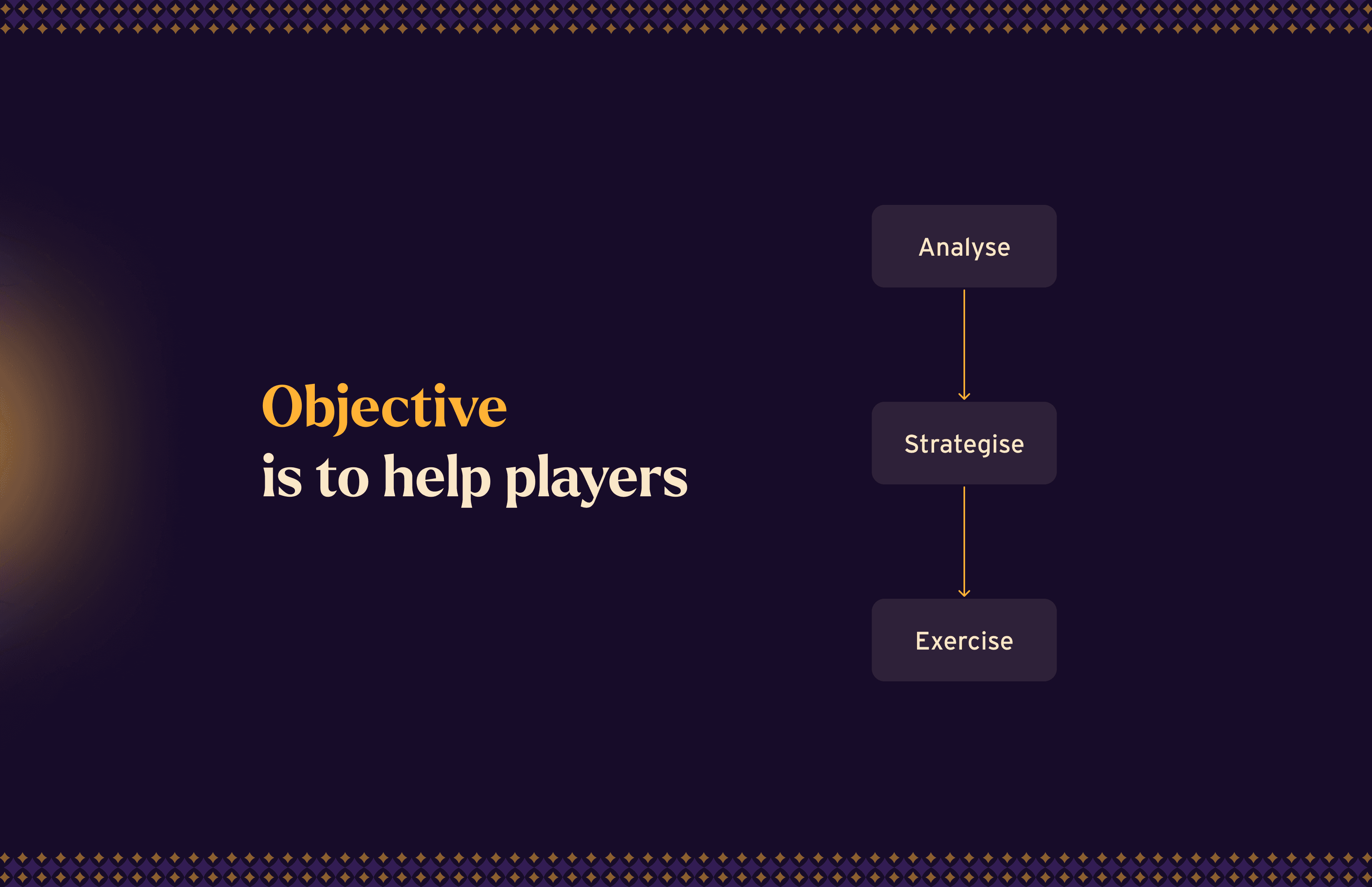
The objective was not simply to provide replay functionality.
The goal was to create a system that would help players:
Analyze
Understand how a game unfolded.
Reflect
Identify mistakes and missed opportunities.
Learn
Discover patterns and strategies.
Improve
Apply insights in future games.
This aligned closely with both player needs and business goals.
My Role
As Design Manager, my contribution focused on defining the product vision and ensuring the team solved the right problem.
Responsibilities
• Leading discovery and research
• Defining strategic direction
• Facilitating stakeholder alignment
• Driving opportunity mapping
• Prioritizing features
• Reviewing experience design
• Collaborating with engineering on feasibility
• Presenting recommendations to leadership
Rather than focusing solely on screen-level design, I was responsible for ensuring the solution balanced:
• User value
• Business impact
• Technical feasibility
Discovery & Research
To understand player behavior, we conducted interviews with players across multiple skill levels.
Player Segments
• Social Players
• Casual Players
• Novice Players
• Experienced Players
• Competitive Players
What We Learned
Different player groups had different motivations, but all of them shared one common need:
They wanted to understand what happened after a game ended.
Experienced and competitive players were especially interested in improving their decision-making and learning from mistakes.
Meanwhile, casual players wanted reassurance that they hadn't missed something obvious.
Across all interviews, players consistently described replay as a learning tool rather than an entertainment feature.
A Key Research Exercise
To better understand post-game thinking, we conducted offline gameplay sessions with high-value players.
Instead of asking players what they wanted, we observed how they reflected immediately after a game ended.
After each match, players naturally began asking questions.
The Questions Players Wanted Answered
During the exercise, we observed a consistent pattern.
Players repeatedly asked:
1. Where did this card come from?
2. What cards did my opponent have at the start?
3. Why did they pick that card?
4. Did they get too many jokers?
5. When was the pure sequence formed?
6. Which move caused me to lose?
7. Was I unlucky or did I play badly?
8. What came from the closed deck?
• This became the most important insight of the project.
• Players weren't looking for replay.
• They were looking for explanations.
Synthesizing Insights
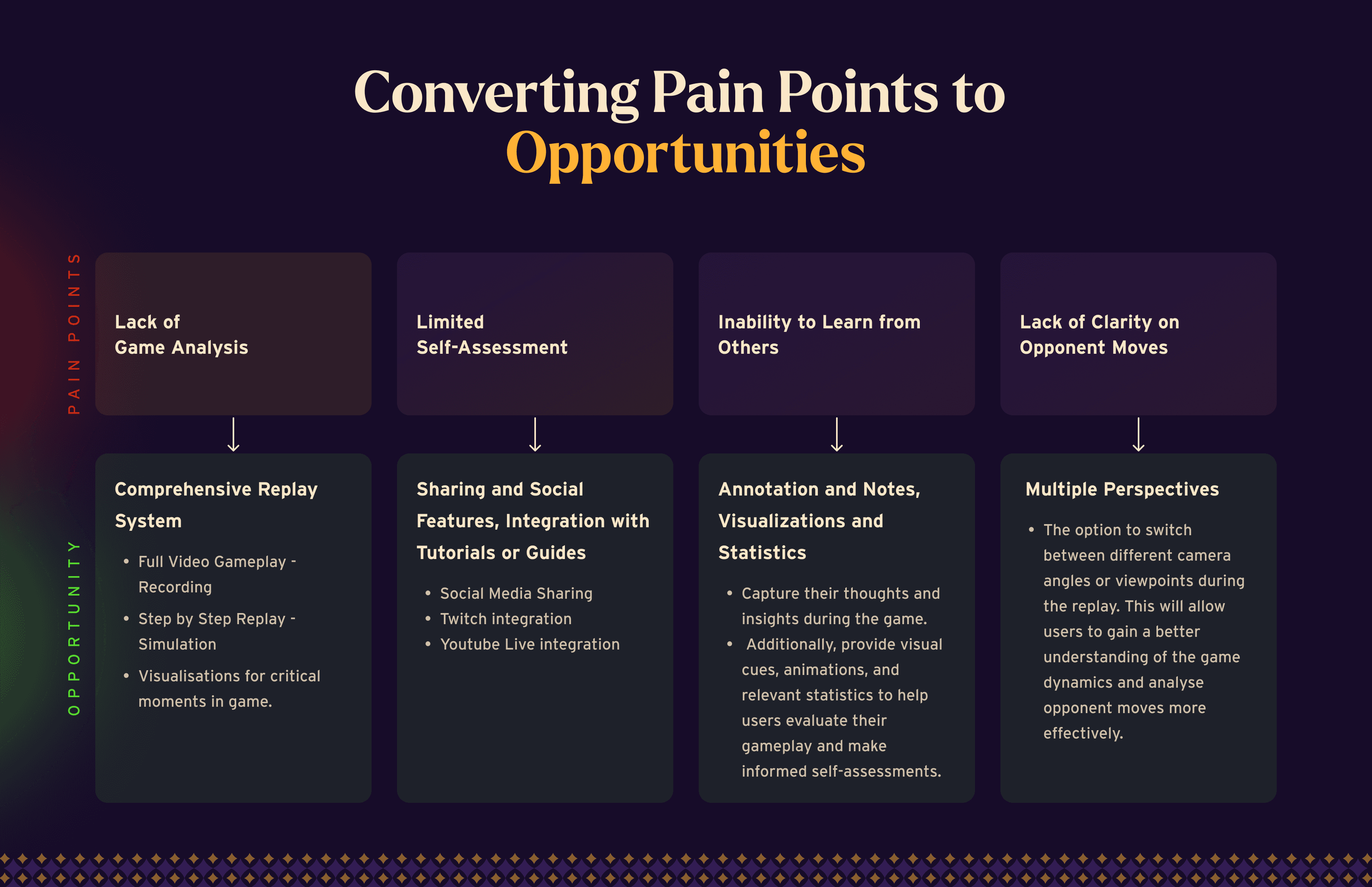
After analyzing research findings, we identified four primary pain points.
Lack of Game Analysis
Players had no way to review how a match evolved over time.
Limited Self-Assessment
Players struggled to evaluate the quality of their decisions.
Inability to Learn From Others
There was no way to study stronger players or understand successful strategies.
Lack of Clarity Around Opponent Moves
Players couldn't understand how opponents built winning hands.

From Pain Points to Opportunities
Rather than jumping into solutions immediately, we mapped each pain point to a potential opportunity.
This framework helped align product, design, and engineering around a shared vision.
Pain Point
Lack of Analysis
Limited Self Assessment
Learning From Others
Opponent Clarity
Opportunity
Interactive Replay
Visual Progress Indicators
Opponent Visibility
Timeline-Based Insights
Product Vision
We defined the vision as:
Turn every completed game into a coaching moment.
• This became the guiding principle for all design decisions.
• The objective was not to recreate gameplay.
• The objective was to help players learn.
Exploring Solutions
The first major decision involved determining how replay should work.
We explored two approaches.
Option 1: Video Replay
A traditional recorded replay similar to watching a video.
Benefits
• Familiar interaction model
• Simple mental model
Challenges
• High storage requirements
• Increased bandwidth costs
• Limited interactivity
• Difficult to analyze specific moments
Option 2: Simulated Replay
A reconstructed replay based on gameplay events.
Benefits
• Lower storage costs
• Faster loading
• Interactive controls
• Ability to inspect specific moments
Challenges
• More complex implementation
Strategic Decision
We chose simulation-based replay.
Although technically more complex, it aligned significantly better with the learning objectives.
Players needed investigation tools, not video playback.
This decision became foundational to the experience.

Designing Around Questions
Instead of designing generic replay controls, we designed the experience around the questions players wanted answered.
Question 1
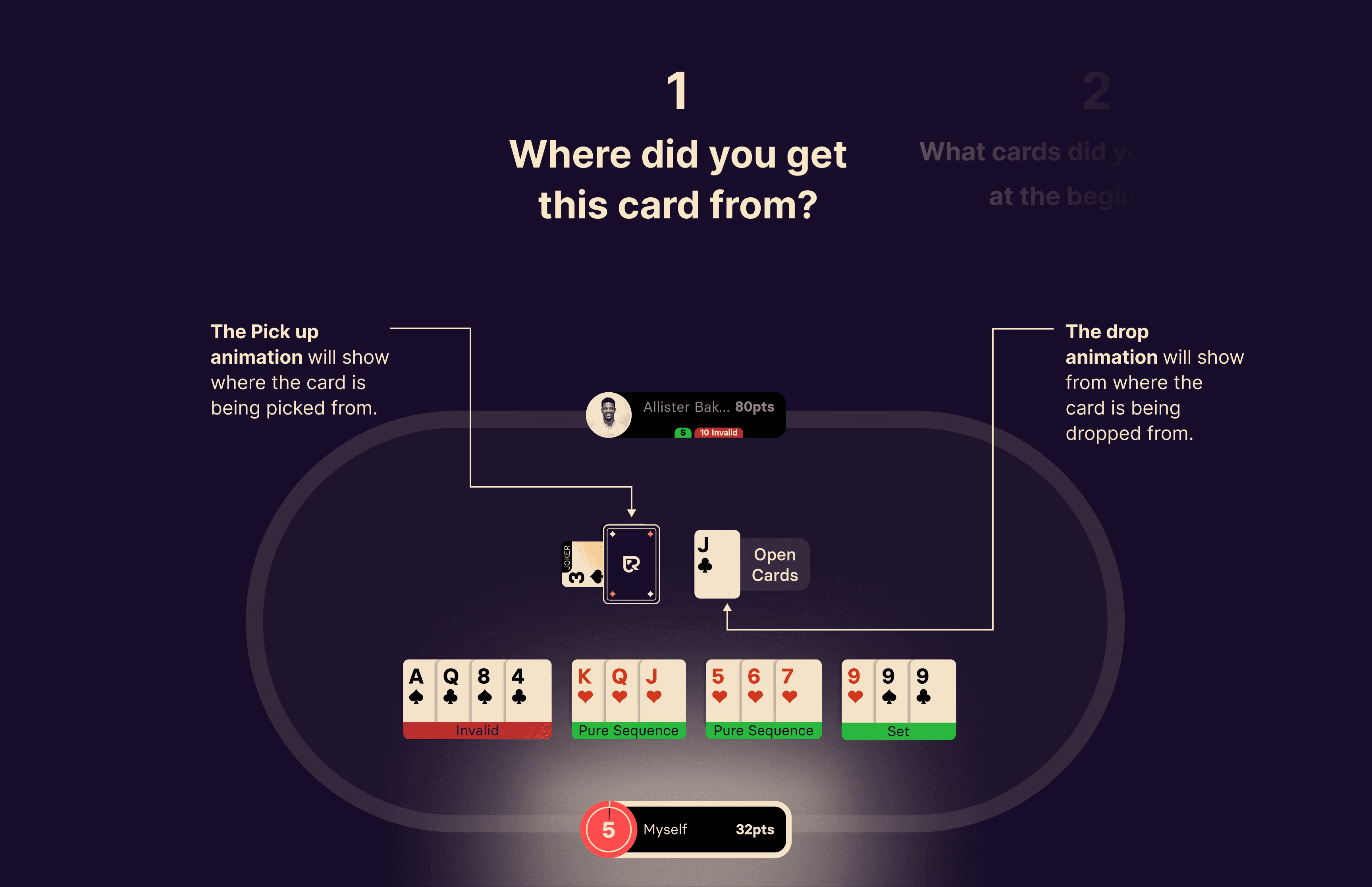
Where Did This Card Come From?
Players needed visibility into card movement.
We introduced:
• Pick-up animations
• Drop animations
• Source indicators
This allowed players to trace the journey of every card.
Question 2
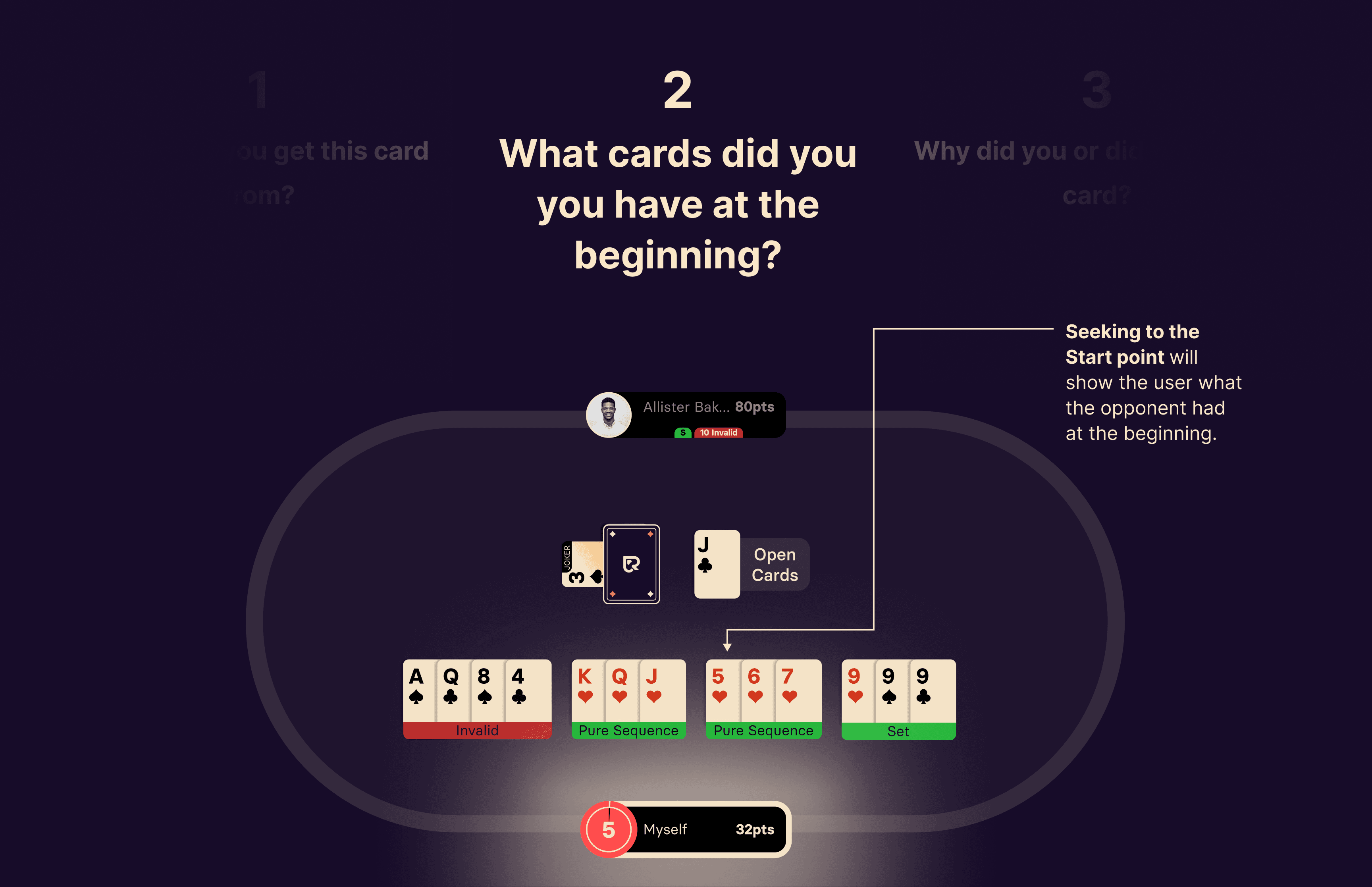
What Did They Start With?
We added timeline controls that allowed players to return to the beginning of the match and inspect initial hands. This provided immediate context for understanding how a player's strategy evolved.
Question 3
Why Was This Card Picked?
We surfaced sequence and set formation states directly within replay.Players could now understand the reasoning behind card selections.

Question 4
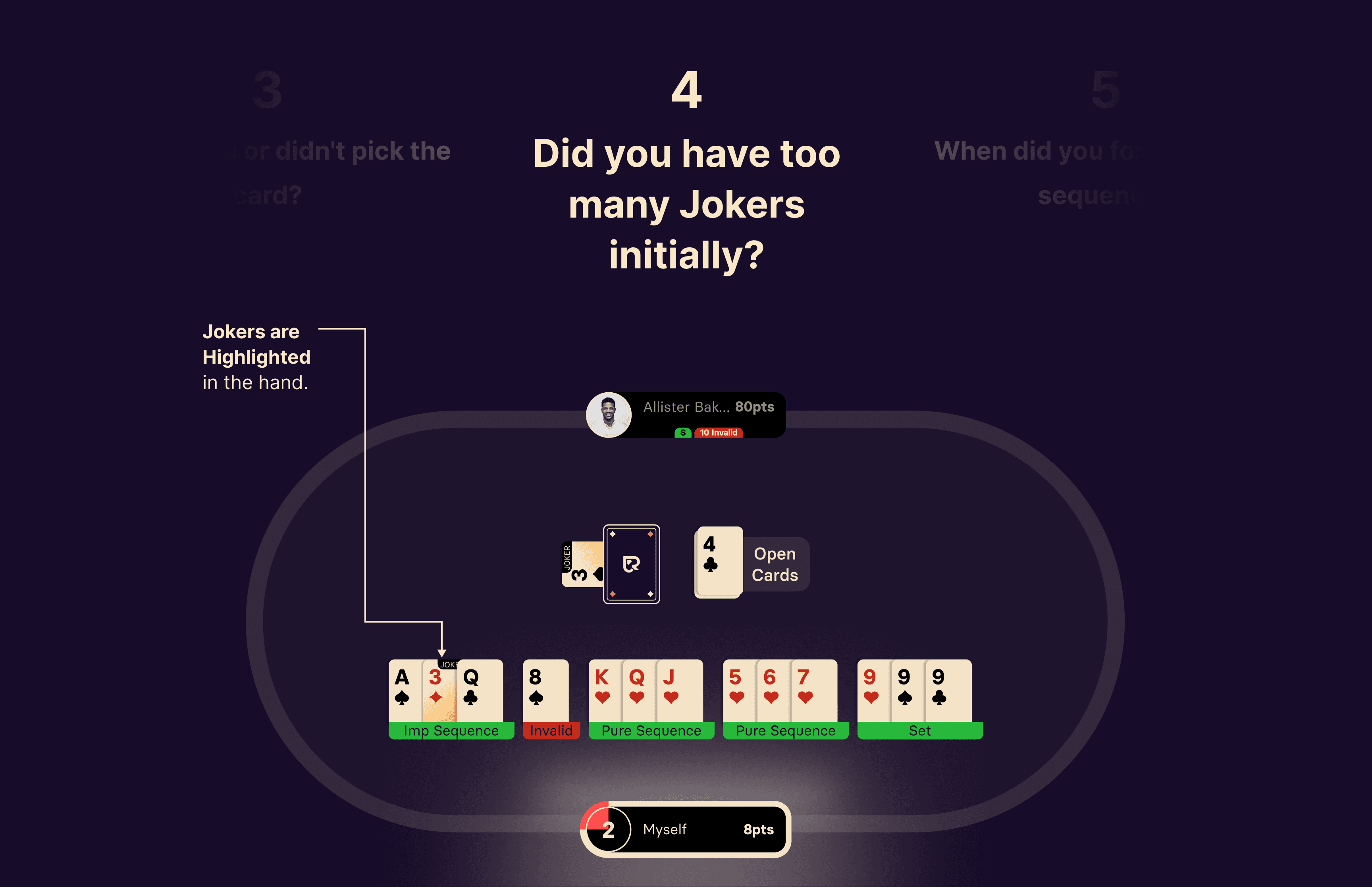
Did They Receive Too Many Jokers?
Many players blamed losses on joker distribution. To address this, jokers were highlighted throughout replay. This increased transparency and reduced speculation.
Question 5
When Was the Pure Sequence Formed?
Pure sequence formation is one of the most critical milestones in Rummy. We visualized sequence progression over time so players could clearly identify key turning points.

Question 6
Which Move Caused Me To Lose?
This became one of our most debated design discussions.
Initially, we considered providing automated recommendations.
However, we decided against it.
Rummy is highly contextual.
Providing direct advice could be misleading and potentially incorrect.
Instead, we focused on giving players enough visibility to draw their own conclusions.

Question 7
Was I Unlucky Or Did I Play Poorly?
Players frequently questioned card distribution after losses.
To address this, we exposed:
• Card dealing order
• Distribution visibility
• Opponent progression
This helped players distinguish luck from decision-making.

Question 8
What Came From The Closed Deck?
We introduced pickup history visibility.
Players could review all cards drawn throughout the game and better understand game progression.

Entry Point Strategy
Replay was designed as an ecosystem rather than a standalone feature.
We identified three key entry points.
Post-Game
Highest player intent.
Immediately after winning or losing.
Mid-Tournament
Players reviewing previous rounds.
My Games
Historical analysis and learning.
Final Replay Experience
From Game Replay to a Player Learning System
The final solution was designed as more than a replay feature.
Our goal was to create a system that helps players understand, analyze, and improve their gameplay through guided exploration and transparent game insights
The experience was built around four key components:
Simulation Replay
Guided Onboarding
Interactive Controls
Learning-Focused Add-ons
Together, these components transformed replay from a passive viewing experience into an active learning tool.
1. Simulation Replay
The foundation of the experience was a simulation-based replay engine.
Instead of recording and replaying a video, the system reconstructed the game state turn-by-turn, allowing players to inspect every action throughout the match.
Players could:
• Revisit completed games
• Analyze game progression
• Understand opponent actions
• Review key decisions
• Explore critical moments at their own pace
Why Simulation Instead of Video?
During discovery, we explored both video replay and simulation replay approaches. Simulation replay was selected because it provided:
• Lower storage costs
• Faster loading
• Interactive controls
• Ability to inspect specific moments
Most importantly, it enabled players to investigate specific moments rather than simply watch a game unfold.
2. Guided Onboarding
One challenge we identified early was discoverability.
Replay introduced a new interaction model that players had never experienced inside the product before.
To reduce friction and encourage adoption, we designed an onboarding experience using contextual coachmarks.
The onboarding introduced players to:
Magic Replay
A guided replay mode that automatically walks players through important moments in the game.
Ideal for:
• New users
• Casual players
• Players seeking quick insights
Single Replay
A manual replay mode that gives players complete control over exploration.
Ideal for:
• Experienced players
• Competitive players
• Deep analysis
To further improve understanding, both modes included short explainer videos demonstrating how replay worked.
Why This Matters
Research showed that players wanted answers quickly.
Instead of requiring users to learn the system independently, onboarding helped them understand the value of replay immediately.
3. Interactive Replay Controls
Replay controls became the core interaction layer of the experience.
Instead of functioning like a traditional video player, the controls were designed specifically for gameplay analysis.
Players could:
Navigate Through Time
Move forward or backward through the game.
Pause at Key Moments
Inspect specific decisions.
Track Game Progress
Understand how the game evolved over time.
Review Important Events
Replay surfaced critical milestones such as:
Pure sequence formation
Set completion
Joker acquisition
Opponent progression
Winning moments
Design Philosophy
1
Players rarely wanted to watch an entire game from start to finish.
2
They wanted to investigate specific moments that influenced the outcome.
3
The replay timeline was designed to support this investigative behavior.
4. Learning-Focused Add-ons
As part of our long-term vision, we explored a set of value-added features that could further enhance player learning.
These concepts extended replay beyond transparency and into skill development.
Potential add-ons included:
Gameplay Suggestions
Helping players identify alternative decisions.
Pattern Recognition
Highlighting recurring gameplay behaviors.
Performance Insights
Helping players understand strengths and weaknesses.
Strategic Recommendations
Surfacing areas for improvement over time.
Why We Treated These As Add-ons
One of the key decisions during the project was to avoid introducing prescriptive coaching into the first version.
Rummy is highly contextual, and automated advice can often be misleading.
Instead, we focused on:
1
Building transparency first
2
Validating replay adoption
3
Exploring advanced learning features later
This phased approach reduced risk while creating a clear product roadmap.
