Role
Product Design Manager
Scope
Accelerate Product Development with AI
Brands
Junglee Games & Raffles
Tools
Figma, Claude, Gemini
AI-Enabled Product Infrastructure for Multi-Brand Platforms
Building Scalable UI Infrastructure to Accelerate Product Development with AI

Overview
At Junglee Games, multiple products operated across different brands, geographies, and betting formats — including poker, raffles, and other gaming experiences. As product complexity increased, the speed of feature rollout and experimentation started slowing down due to fragmented UI structures and duplicated effort across teams.
I initiated and proposed a strategic infrastructure initiative focused on creating an AI-ready
shared product UI infrastructure that would:
• Standardize foundational UI architecture
• Support multiple brands and markets
• Enable AI-assisted product development
• Improve product velocity across teams
The goal was not just consistency — it was to create a scalable infrastructure layer that could significantly accelerate future product creation using AI tools like Claude and Gemini.
Problem
As the organization scaled, several operational bottlenecks emerged:
Fragmented Product Structures
Each product evolved independently with its own:
● UI patterns
● components
● layouts
● visual structures
This created duplication and slowed feature development.
Multi-Brand Complexity
Different gaming products required:
● unique branding
● market-specific customization
● localized UX patterns
Scaling across brands became increasingly inefficient.
Slower Product Velocity
Feature development involved repetitive manual effort:
● recreating screens
● redesigning patterns
● rebuilding layouts
This increased both design and engineering overhead.
AI Couldn’t Be Leveraged Effectively
Modern AI tools require structured systems to generate reliable outputs. Because the product ecosystem lacked unified infrastructure, AI-generated UI workflows were inconsistent and difficult to scale.

Opportunity
I identified an opportunity to treat UI architecture as shared infrastructure, similar to platform engineering.
The vision was: Build AI-ready product infrastructure that allows AI tools to accelerate product development across multiple brands and products.
Instead of designing each product independently,the system would separate:
● structure
● branding
● templates
● product logic
This would allow both humans and AI systems to build products significantly faster.
Approach
Infrastructure-First Thinking
Rather than positioning this as a “design system,” I reframed it internally as:
Product UI Infrastructure
This aligned the initiative more closely with:
● scalability
● execution speed
● platform architecture
● operational efficiency
This aligned the initiative more closely with:
System Architecture
The infrastructure was structured into multiple scalable layers:

Multi-Brand Infrastructure
The system was designed to support multiple gaming brands using a shared foundation. Instead of duplicating components for each brand, I implemented:
Shared Components
Reusable components across all products:
● navigation
● cards
● betting modules
● onboarding patterns
● transactional flows
Instead of hardcoding values like 4px or 16px, spacing tokens are derived from a
consistent scale.
This ensures proportional rhythm across the entire system.
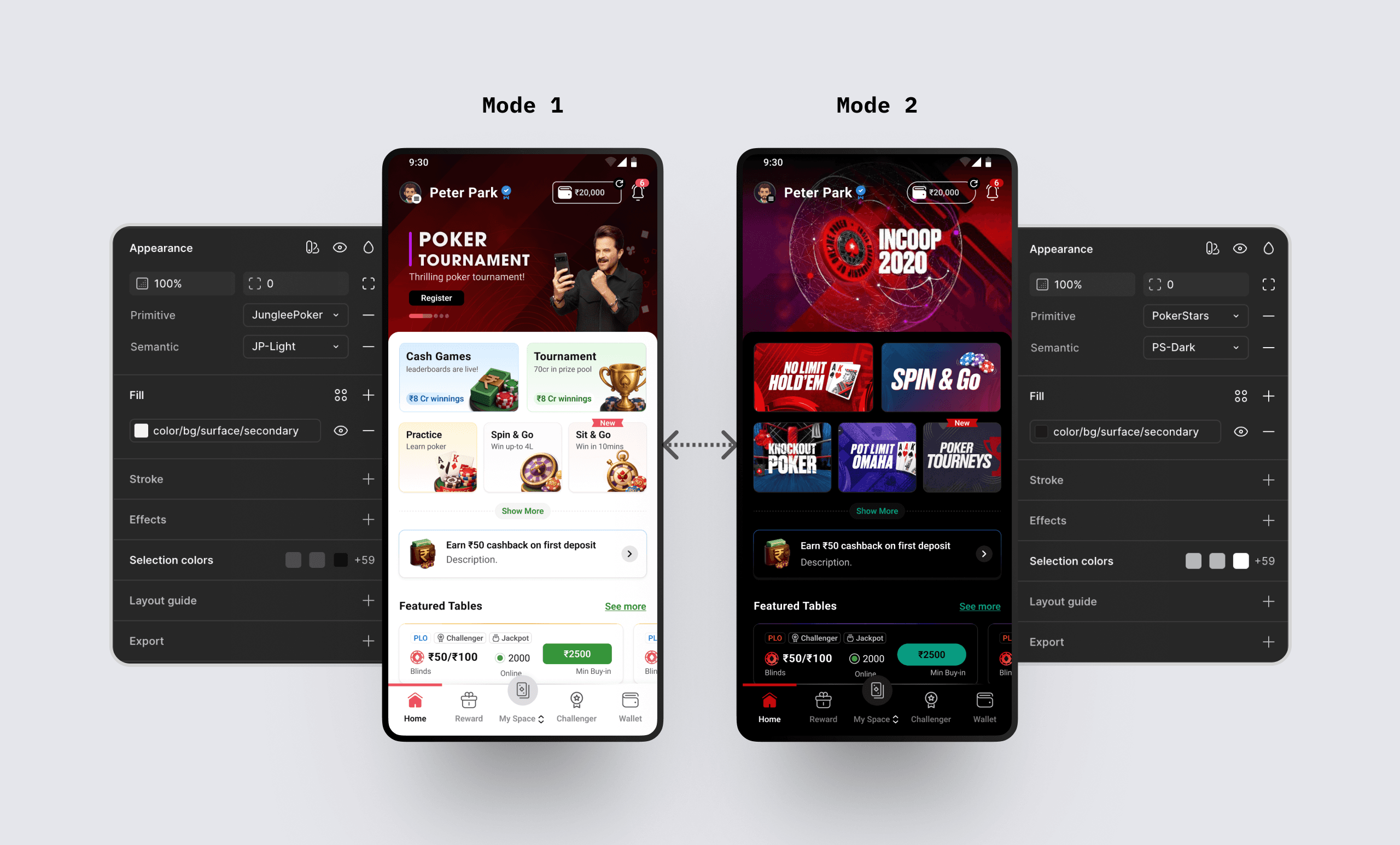
Brand Modes
Brand-specific visual identities were controlled through variable modes:
● Poker
● Raffles
● Country variants
● Future products
This allowed one shared structure to adapt visually without rebuilding screens.